


The Ultimate Microsoft SC-300 Dumps PDF Review
Achieve The Utmost Performance In SC-300 Exam Pass Guaranteed
NEW QUESTION # 131
You have an Azure AD tenant that contains the users shown in the following table.
The tenant has the authentication methods shown in the following table.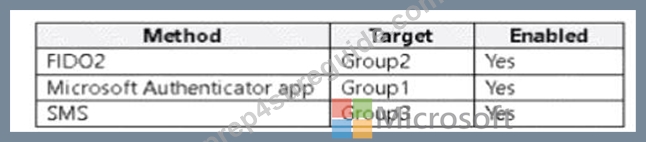
Which users will sign in to cloud apps by matching a number shown in the app with a number shown on their phone?
- A. User3 only
- B. User2 only
- C. User1 and User2 only
- D. User2 and User3 only
- E. User1 only
Answer: E
NEW QUESTION # 132
You have an Azure AD tenant that contains the users shown in the following table.
You have the Azure AD Identity Protection policies shown in the following table.
You review the Risky users report and the Risky sign-ins report and perform actions for each user as shown in the following table.
For each of the following statements, select Yes if the statement is true. Otherwise, select No.
NOTE: Each correct selection is worth one point.
Answer:
Explanation: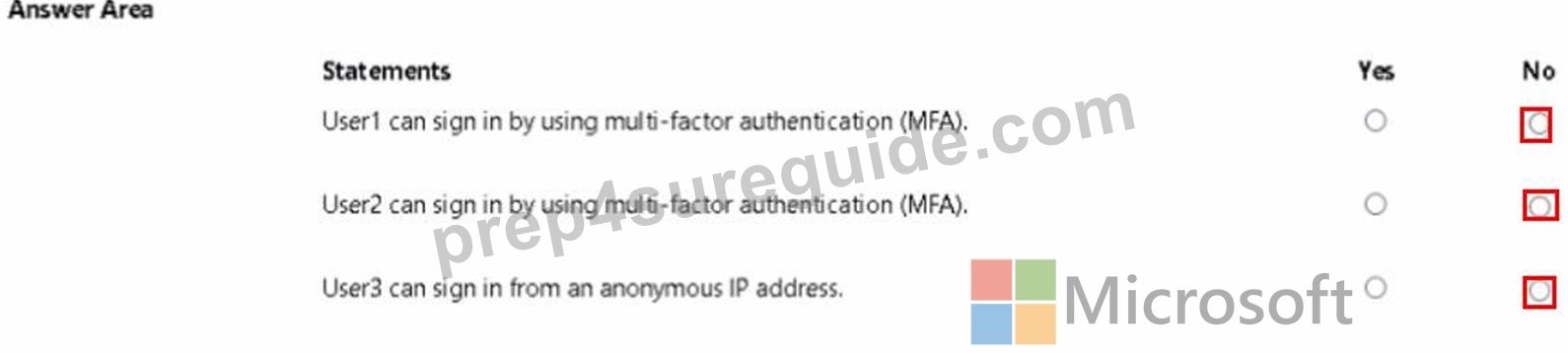
NEW QUESTION # 133
You have an Azure AD tenant that contains the users shown in the following table.
In Azure AD Identity Protection, you configure a user risk policy that has the following settings:
* Assignments:
o Users: Group1
o User risk: Low and above
* Controls:
o Access: Block access
* Enforce policy: On
In Azure AD Identity Protection, you configure a sign-in risk policy that has the following settings:
* Assignments:
o Users: Group2
o Sign-in risk: Low and above
* Controls:
o Access: Require multi-factor authentication
* Enforce policy. On
the following settings:
ng settings:
For each of the following statements, select Yes if the statement is true. Otherwise, select No.
NOTE: Each correct selection is worth one point.
Answer:
Explanation:
Explanation: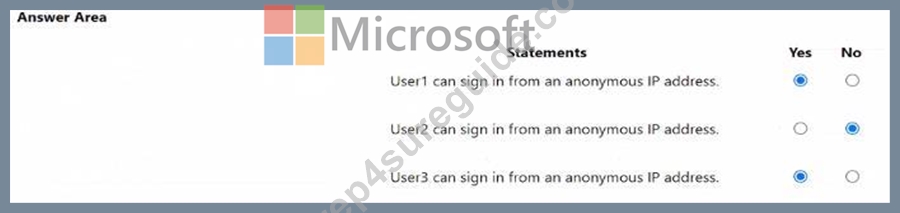
NEW QUESTION # 134
Your network contains an on-premises Active Directory domain that syncs to an Azure Active Directory (Azure AD) tenant. The tenant contains the users shown in the following table.
All the users work remotely.
Azure AD Connect is configured in Azure AD as shown in the following exhibit.
Connectivity from the on-premises domain to the internet is lost.
Which users can sign in to Azure AD?
- A. User1 only
- B. User1 and User2 only
- C. User1 and User3 only
- D. User1, User2, and User3
Answer: D
Explanation:
The exhibit shows Password Hash Synchronization (PHS) enabled and Pass-through Authentication (PTA) enabled. The SC-300 materials clarify that when both PTA and PHS are enabled, Azure AD can fall back to PHS if PTA agents become unavailable. The guidance states that PHS can serve as a backup sign-in method to ensure continuity during on-premises connectivity failures. In this scenario, on-premises connectivity to the internet is lost, so PTA agents cannot process sign-ins. Because PHS is enabled, synchronized users can still authenticate in Azure AD using their synced password hashes.
* User1 is a cloud-only user and authenticates directly in Azure AD-unaffected by on-premises outages.
* User2 is directory-synced; with PTA down, sign-in falls back to PHS, allowing access as long as the hash is present.
* User3 is a guest; guests authenticate in their home directory/IdP, independent of your on-premises environment, so they can still sign in.Therefore, during the outage, all three users (User1, User2, and User3) can sign in to Azure AD, satisfying the behavior described in the SC-300 documentation regarding PHS backup for PTA and guest sign-in independence.
NEW QUESTION # 135
You have an Azure Active Directory (Azure AD) tenant.
You configure self-service password reset (SSPR) by using the following settings:
* Require users to register when signing in: Yes
* Number of methods required to reset: 1
What is a valid authentication method available to users?
- A. home prions
- B. a mobile app code
- C. mobile app notification
- D. an email to an address in your organization
Answer: D
NEW QUESTION # 136
Hotspot Question
You have an Azure subscription that contains the following virtual machine:
- Name: V1
- Azure region: East US
- System-assigned managed identity: Disabled
You create the managed identities shown in the following table.
You perform the following actions:
- Assign Managed1 to V1.
- Create a resource group named RG1 in the West US region.
For each of the following statements, select Yes if the statement is true. Otherwise, select No.
NOTE: Each correct selection is worth one point.
Answer:
Explanation:
Explanation:
You can use user assigned managed identities in more than one Azure region.
https://learn.microsoft.com/en-us/azure/active-directory/managed-identities-azure- resources/managed-identities-faq#can-the-same-managed-identity-be-used-across-multiple- regions
NEW QUESTION # 137
You have a new Microsoft 365 tenant that uses a domain name of contoso.conmicrosoft.com.
You register the name contoso.com with a domain registrar.
You need to use contoso.com as the default domain name for new Microsoft 365 users.
Which four actions should you perform in sequenced? To answer, move the appropriate actions from the list of actions to the answer area and arrange them in the correct order.
Answer:
Explanation:
1 - Create a new TXT record in DNS.
2 - Register a custom domain name of contos.com.
3 - Set the domain to primary.
4 - Verify the domain name.
NEW QUESTION # 138
You have an Azure AD tenant named contoso.com that contains the resources shown in the following table.
You create a user named Admin 1.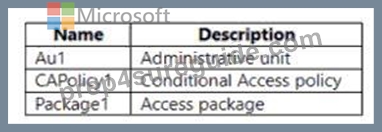
You need to ensure that Admin can enable Security defaults for contoso.com.
What should you do first?
- A. Assign Admin1 the Authentication administrator role for Au1
- B. Configure Identity Governance.
- C. Delete CAPolicy1.
- D. Delete Package1.
Answer: A
Explanation:
To enable Security defaults for contoso.com, you should first sign in to the Azure portal as a security administrator, Conditional Access administrator, or global administrator. Then, browse to Azure Active Directory > Properties and select Manage security defaults. Set the Enable security defaults toggle to Yes and select Save.
After that, you can assign Admin1 the Identity Administrator role for Au1 to enable them to manage security defaults for the tenant.
https://practical365.com/what-are-azure-ad-security-defaults-and-should-you-use-them/
NEW QUESTION # 139
You have a Microsoft 365 E5 subscription.
You need to configure app consent for the subscription. The solution must meet the following requirements:
* Disable user consent to apps.
* Configure admin consent workflow for apps.
Which portal should you use for each requirement? To answer, select the appropriate options in the answer are a. NOTE Each correct selection is worth one point
Answer:
Explanation:
NEW QUESTION # 140
You have an Azure subscription that contains the key vaults shown in the following table.
The subscription contains the users shown in the following table.
On June1, Admin4 performs the following actions:
* Deletes a certificate named Certificate! from Key Vault1
* Deletes a secret named Secret1 from KeyVault2
For each of the following statements, select Yes if the statement is true. Otherwise, select No.
NOTE: Each correct selection is worth one point.
Answer:
Explanation:
Explanation:
Azure Key Vault uses soft delete with a configurable retention period (7-90 days). During this window, deleted objects can be recovered, and if purge protection is enabled, they cannot be purged until the retention period expires. The SC-300 materials describe: "Soft-delete retains keys, secrets, and certificates for the configured retention days. When purge protection is enabled, even users with purge permission cannot permanently delete objects before the retention period ends; objects remain recoverable until expiry." The Key Vault RBAC data-plane roles further clarify capabilities. The guide states: "Key Vault Administrator has full data actions, including recover and purge across keys, secrets, and certificates. Key Vault Contributor manages the vault resource and settings but does not have data-plane permissions to read, delete, purge, or recover objects. Certificates Officer can manage and recover certificates but is not granted purge." Applying this:
* Secret1 was deleted on June 1 from KeyVault2 (retention 10 days, purge protection Disabled). If it hasn' t been purged, it is recoverable any time through June 11. Admin1 (Key Vault Administrator) therefore can recover on June 7.
* Certificate1 was deleted on June 1 from KeyVault1 (retention 15 days, purge protection Enabled).
Purge is blocked until June 16 regardless of role. Additionally, Admin2 (Key Vault Contributor) lacks data-plane purge rights. Hence cannot purge on June 12.
* Admin3 (Key Vault Certificates Officer) also lacks purge permission; with purge protection still in effect, cannot purge on June 14.
NEW QUESTION # 141
You have a Microsoft 365 E5 subscription.
You deploy a third-party web gateway named Gateway1.
You need to integrate Gateway1 with Microsoft Defender for Cloud Apps. The solution must meet the following requirements:
* Ensure that data flows automatically to Defender for Cloud Apps.
* Minimize administrative effort.
What should you do first?
- A. Create an app registration
- B. Add a data source
- C. Create a snapshot report
- D. Add a log collector
Answer: D
Explanation:
Comprehensive and Detailed In-Depth Explanation:
Let's break this down step by step based on Microsoft Defender for Cloud Apps (MDCA) integration with third-party web gateways, as outlined in Microsoft Identity and Access Administrator documentation.
* Understanding the Scenario and Requirements:
* Microsoft 365 E5 subscription:This subscription includes Microsoft Defender for Cloud Apps, which provides the necessary licensing for integrating with third-party web gateways.
* Third-party web gateway named Gateway1:A web gateway (e.g., a Secure Web Gateway like Zscaler, Netskope, or Symantec) is deployed to manage and secure internet traffic. The question does not specify the vendor, but the process for integration with MDCA is generally the same for supported gateways.
* Requirement:Integrate Gateway1 with Microsoft Defender for Cloud Apps to ensure that data (e.
g., traffic logs, events) flows automatically to MDCA for analysis, visibility, and policy enforcement. The solution must also minimize administrative effort.
* Microsoft Defender for Cloud Apps supports integration with third-party web gateways to provide visibility into cloud app usage, detect shadow IT, and enforce security policies. This integration typically involves collecting logs from the gateway for analysis in MDCA.
* How Microsoft Defender for Cloud Apps Integrates with Third-Party Web Gateways:
* MDCA can integrate with third-party web gateways by collecting logs that contain traffic data (e.
g., user activity, app usage, IP addresses). This allows MDCA to analyze the data and provide insights into cloud app usage, detect threats, and enforce policies.
* The primary method for integrating a third-party web gateway with MDCA is toadd a log collector. This involves:
* Configuring the web gateway to send logs to a log collector (e.g., via Syslog or FTP).
* Setting up a log collector in MDCA to receive and process these logs.
* Once configured, the log collector automatically pulls logs from the web gateway, ensuring that data flows to MDCA for analysis.
* This method supports automatic data flow and minimizes administrative effort because, after the initial setup, the log collection process runs continuously without manual intervention.
* Analyzing the Options:
* A. Add a data source:
* In Microsoft Defender for Cloud Apps, "data sources" typically refer to sources of user activity data, such as Microsoft Entra ID audit logs, Microsoft 365 audit logs, or other Microsoft services. Adding a data source in MDCA is used to import user activity data for correlation with cloud app usage, but it is not the mechanism for integrating a third-party web gateway.
* Third-party web gateways are not considered "data sources" in MDCA; instead, they are integrated via log collectors.
* Conclusion:This option is incorrect because adding a data source does not facilitate integration with a third-party web gateway like Gateway1.
* B. Create an app registration:
* Creating an app registration in Microsoft Entra ID is typically used to integrate cloud apps with MDCA for session control (e.g., via Conditional Access App Control) or to enable API-based log collection for supported apps (e.g., Salesforce, Box).
* However, a third-party web gateway like Gateway1 is not a cloud app that requires an app registration. Web gateways are network appliances or services that manage traffic, and their integration with MDCA involves log collection, not app registration.
* Conclusion:This option is incorrect because creating an app registration is not relevant to integrating a web gateway with MDCA.
* C. Create a snapshot report:
* A snapshot report in MDCA is a manual process where an administrator uploads a log file (e.g., a CSV or JSON file) from a third-party service to analyze cloud app usage. This is a one-time, manual process used for discovery (e.g., to identify shadow IT).
* The requirement specifies that data must flow "automatically" to Defender for Cloud Apps, and a snapshot report does not meet this requirement because it requires manual uploads each time. It also does not minimize administrative effort due to the ongoing manual intervention.
* Conclusion:This option is incorrect because creating a snapshot report does not enable automatic data flow and increases administrative effort.
* D. Add a log collector:
* Adding a log collector in Microsoft Defender for Cloud Apps is the standard method for integrating third-party web gateways. MDCA supports log collection from many web gateways (e.g., Zscaler, Netskope, Symantec) via Syslog or FTP.
* Process:
* In the Microsoft Defender for Cloud Apps portal, navigate toSettings > Log collectors.
* Add a new log collector, specifying the protocol (e.g., Syslog over TCP/UDP or FTP) and the details of the web gateway (e.g., IP address, port).
* Configure Gateway1 to send logs to the log collector (this step is done on the Gateway1 side, typically by the network team).
* Once set up, the log collector automatically collects logs from Gateway1 and processes them in MDCA for analysis.
* Automatic Data Flow:The log collector ensures that data flows automatically to MDCA, meeting the first requirement.
* Minimize Administrative Effort:After the initial setup, the log collector runs continuously without manual intervention, minimizing administrative effort.
* Conclusion:This option is correct because adding a log collector is the first step to integrate Gateway1 with MDCA, ensuring automatic data flow and minimizing administrative effort.
* Why "Add a log collector" is the First Step:
* The question asks for the first step to integrate Gateway1 with Microsoft Defender for Cloud Apps. Adding a log collector is the initial action in MDCA to enable log collection from a third- party web gateway.
* Subsequent steps (not asked in the question) would include configuring Gateway1 to send logs to the log collector, but this is done outside MDCA (e.g., in Gateway1's management console). The question focuses on the action in MDCA, making "Add a log collector" the correct first step.
* Additional Considerations:
* The question does not specify the vendor of Gateway1, but Microsoft Defender for Cloud Apps supports log collection from many third-party web gateways (e.g., Zscaler, Netskope, Symantec, Cisco Umbrella). The process is the same regardless of the vendor, as long as the gateway supports Syslog or FTP log export.
* If Gateway1 were not a supported web gateway, additional steps (e.g., custom log parsing) might be required, but the question implies Gateway1 can be integrated using standard methods.
* The Microsoft 365 E5 subscription includes Microsoft Defender for Cloud Apps, so no additional licensing is required.
* Conclusion:To integrate Gateway1 with Microsoft Defender for Cloud Apps, ensuring that data flows automatically and minimizing administrative effort, the first step is toadd a log collectorin MDCA.
This sets up the infrastructure to receive logs from Gateway1, enabling automatic data flow for analysis. Therefore, the correct answer isD.
References:
Microsoft Defender for Cloud Apps documentation: "Integrate with a third-party web gateway" (Microsoft Learn:https://learn.microsoft.com/en-us/defender-cloud-apps/connect-third-party-gateway) Microsoft Defender for Cloud Apps documentation: "Set up a log collector" (Microsoft Learn:https://learn.
microsoft.com/en-us/defender-cloud-apps/log-collector)
Microsoft Identity and Access Administrator (SC-300) exam study guide, which covers integrating Microsoft Defender for Cloud Apps with third-party services for cloud app visibility and control.
NEW QUESTION # 142
You need to resolve the issue of IT.Group1. What should you do first?
- A. Recreate the IT_Group 1 group.
- B. Change Membership type of IT.Group1 to Dynamic User
- C. Change Membership type of IT.Group1 to Dynamic Device
- D. Add an owner to IT_Group1.
Answer: C
NEW QUESTION # 143
You have a Microsoft 365 E5 subscription.
Users authorize third-party cloud apps to access their data.
You need to configure an alert that will be triggered when an app requires high permissions and is authorized by more than 20 users.
Which type of policy should you create in the Microsoft Defender for Cloud Apps portal?
- A. activity policy
- B. anomaly detection policy
- C. access policy
- D. OAuth app policy
Answer: A
NEW QUESTION # 144
You have an Azure Active Directory (Azure AD) tenant that contains the users shown in the following table.
You plan to implement Azure AD Identity Protection.
Which users can configure the user risk policy, and which users can view the risky users report? To answer, select the appropriate options in the answer area.
NOTE:Each correct selection is worth one point.
Answer:
Explanation:
Explanation: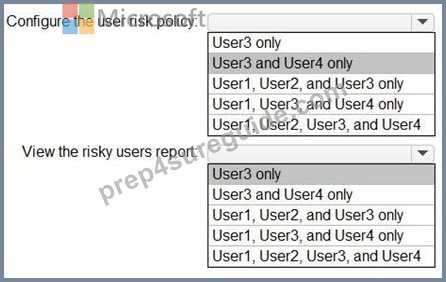
Reference:
https://docs.microsoft.com/en-us/azure/active-directory/identity-protection/overview-identity-protection
NEW QUESTION # 145
Hotspot Question
You have a hybrid Microsoft 365 subscription that contains the users shown in the following table.
You plan to deploy an on-premises app named App1. App1 will be registered in Azure AD and will use Azure AD Application Proxy.
You need to delegate the installation of the Application Proxy connector and ensure that User1 can register App1 in Azure AD. The solution must use the principle of least privilege.
Which user should perform the installation, and which role should you assign to User1? To answer, select the appropriate options in the answer area.
NOTE: Each correct selection is worth one point.
Answer:
Explanation:
NEW QUESTION # 146
You need to implement the planned changes and technical requirements for the marketing department.
What should you do? To answer, select the appropriate options in the answer area.
NOTE: Each correct selection is worth one point.
Answer:
Explanation:
Explanation:
Reference:
https://docs.microsoft.com/en-us/azure/active-directory/governance/entitlement-management-organization
NEW QUESTION # 147
SIMULATION
Task 2
You need to implement a process to review guest users who have access to the Salesforce app. The review must meet the following requirements:
* The reviews must occur monthly.
* The manager of each guest user must review the access.
* If the reviews are NOT completed within five days, access must be removed.
* If the guest user does not have a manager, Megan Bowen must review the access.
Answer:
Explanation:
See the Explanation for the complete step by step solution
Explanation:
To implement a process for reviewing guest users' access to the Salesforce app with the specified requirements, you can use Microsoft Entra's Identity Governance access reviews feature. Here's a step-by-step guide:
Assign the appropriate role:
Ensure you have one of the following roles: Global Administrator, User Administrator, or Identity Governance Administrator1.
Navigate to Identity Governance:
Sign in to the Microsoft Entra admin center.
Go toIdentity governance>Access reviews1.
Create a new access review:
Select New access review.
Choose the Salesforce app to review guest user access1.
Configure the review settings:
Set the frequency of the review to monthly.
Define thedurationof the review period to5 days1.
Determine the reviewers:
Assign the manager of each guest user as the reviewer.
If a guest user does not have a manager, assignMegan Bowenas the reviewer1.
Automate the removal process:
Configure settings toautomatically remove accessif the review is not completed within the specified time frame1.
Monitor and enforce compliance:
Regularly check the access review results to ensure compliance with the review policy1.
Communicate the process:
Inform all stakeholders about the new review process and provide guidance on how to complete the reviews.
NEW QUESTION # 148
......
Achive your Success with Latest Microsoft SC-300 Exam: https://exam-labs.prep4sureguide.com/SC-300-prep4sure-exam-guide.html