


Exam Dumps L6M2 Practice Free Latest CIPS Practice Tests
L6M2 Exam Questions | Real L6M2 Practice Dumps
CIPS L6M2 Exam Syllabus Topics:
| Topic | Details |
|---|---|
| Topic 1 |
|
| Topic 2 |
|
| Topic 3 |
|
| Topic 4 |
|
NEW QUESTION # 19
SIMULATION
Describe and evaluate the use of the VRIO Framework in understanding the internal resources and competencies of an organisation.
Answer:
Explanation:
The VRIO Framework: Understanding Internal Resources and Competencies
The VRIO Framework is a strategic analysis tool used to assess an organization's internal resources and competencies to determine whether they provide a sustainable competitive advantage. Developed by Jay Barney, VRIO stands for Value, Rarity, Imitability, and Organization.
1. Explanation of the VRIO Framework
The VRIO model evaluates whether a firm's resources and capabilities contribute to a sustained competitive advantage.
Example: Apple's software ecosystem (iOS, App Store) is valuable, rare, hard to imitate, and well-organized, giving it a sustainable competitive advantage.
2. The Use of VRIO in Assessing Internal Resources and Competencies
Companies use the VRIO framework to identify which resources provide temporary or sustainable competitive advantages.
3. Advantages of Using VRIO in Strategic Decision-Making
✅ Identifies Core Competencies - Helps organizations focus on key strengths that drive long-term success.
✅ Guides Investment Decisions - Encourages businesses to invest in resources that are difficult to imitate.
✅ Improves Competitive Strategy - Helps firms differentiate between short-term vs. long-term advantages.
Example: Coca-Cola's brand equity is VRIO-positive, making it difficult for new entrants to replicate.
4. Limitations of the VRIO Framework
❌ Ignores External Factors - Unlike PESTLE or Porter's Five Forces, VRIO does not account for market conditions or regulatory changes.
❌ Subjectivity in Resource Evaluation - Assessing whether a resource is truly valuable or rare can be complex.
❌ Lack of Actionable Steps - VRIO identifies competitive strengths but does not provide strategies for leveraging them.
Example: A company may identify a rare talent pool, but poor organizational structure (O) can prevent it from leveraging this advantage.
5. Application of VRIO in Business Strategy
Businesses across different industries use VRIO to assess their internal strengths:
Conclusion
The VRIO Framework is a valuable tool for evaluating internal resources and capabilities, allowing businesses to identify sustainable competitive advantages. However, it should be used alongside external analysis tools (e.g., PESTLE, SWOT) to ensure a comprehensive strategic assessment.
NEW QUESTION # 20
SIMULATION
Why is it important for an organisation to measure performance? Describe one tool that can be used to measure performance
Answer:
Explanation:
Importance of Measuring Performance & Performance Measurement Tool
Introduction
Performance measurement is essential for organizations to evaluate their efficiency, effectiveness, and strategic success. It provides quantifiable insights into business operations, helping companies make data-driven decisions, improve productivity, and maintain competitive advantage.
To achieve this, organizations use various performance measurement tools. One widely used tool is the Balanced Scorecard (BSC), which provides a holistic approach to measuring performance across different business areas.
1. Importance of Measuring Performance
Organizations must measure performance to achieve the following benefits:
1.1 Supports Strategic Decision-Making
✅ Helps businesses align operations with strategic goals.
✅ Identifies areas needing improvement or investment.
Example: A company analyzing supply chain delays can make informed decisions on sourcing alternative suppliers.
1.2 Improves Efficiency and Productivity
✅ Tracks operational effectiveness to reduce waste and costs.
✅ Ensures departments meet KPIs (Key Performance Indicators).
Example: A manufacturer measuring production efficiency can identify bottlenecks and streamline processes.
1.3 Enhances Customer Satisfaction and Quality Control
✅ Monitoring performance ensures high product/service quality.
✅ Helps companies respond to customer expectations and feedback.
Example: A retail company tracking customer complaint resolution times can improve customer service.
1.4 Ensures Financial Stability and Profitability
✅ Measures profit margins, cost efficiency, and revenue growth.
✅ Assists in budgeting and financial planning.
Example: A business monitoring cash flow and profitability ratios can detect financial risks early.
1.5 Supports Continuous Improvement and Benchmarking
✅ Allows companies to compare their performance with competitors.
✅ Encourages a culture of continuous improvement.
Example: A company benchmarking its sustainability metrics against industry leaders can enhance CSR strategies.
2. Performance Measurement Tool - The Balanced Scorecard (BSC)
One widely used performance measurement tool is the Balanced Scorecard (BSC).
2.1 Explanation of the Balanced Scorecard
The Balanced Scorecard (BSC), developed by Kaplan and Norton, measures performance across four key perspectives:
2.2 Application of BSC in Performance Measurement
✅ Holistic View: Measures financial and non-financial performance.
✅ Strategic Alignment: Ensures all departments contribute to business goals.
✅ Data-Driven Decision-Making: Provides insights for process improvements and competitive positioning.
Example:
A logistics company implementing BSC could track:
Financial: Cost per delivery
Customer: Delivery accuracy and satisfaction scores
Internal Processes: Warehouse efficiency
Learning & Growth: Employee training on automation tools
3. Advantages and Limitations of the Balanced Scorecard
✅ Advantages
✔ Aligns performance measurement with business strategy.
✔ Ensures balanced focus across financial and operational areas.
✔ Encourages continuous improvement through KPI tracking.
❌ Limitations
✖ Can be complex and time-consuming to implement.
✖ Needs regular updates to remain relevant.
✖ May require cultural change for adoption across all departments.
Conclusion
Measuring performance is essential for strategic decision-making, operational efficiency, customer satisfaction, financial stability, and continuous improvement. The Balanced Scorecard (BSC) is a powerful tool that provides a comprehensive performance assessment, helping organizations maintain a sustainable competitive advantage.
NEW QUESTION # 21
SIMULATION
XYZ is a manufacturing company based in the UK. It has a large complex supply chain and imports raw materials from Argentina and South Africa. It sells completed products internationally via their website. Evaluate the role of licencing and taxation on XYZ's operations.
Answer:
Explanation:
Evaluation of the Role of Licensing and Taxation on XYZ's Operations
Introduction
Licensing and taxation play a critical role in international trade, supply chain management, and overall financial performance. For XYZ, a UK-based manufacturing company that imports raw materials from Argentina and South Africa and sells internationally via an e-commerce platform, compliance with licensing and taxation regulations is essential to ensure smooth operations, cost efficiency, and legal compliance.
This evaluation will assess the impact of licensing and taxation on XYZ's global supply chain, import/export activities, and financial performance.
1. The Role of Licensing in XYZ's Operations
1.1 Import and Export Licensing Regulations
As XYZ imports raw materials from Argentina and South Africa, it must comply with the UK's import licensing requirements and trade agreements with these countries.
✅ Impact on XYZ:
Import licenses may be required for certain restricted raw materials (e.g., metals, chemicals, agricultural products).
Export control laws may apply, depending on the destination of final products.
Delays or fines may occur if licenses are not properly managed.
Example: If XYZ imports metal components subject to UK trade restrictions, it must secure import licenses before shipment clearance.
1.2 Industry-Specific Licensing Requirements
Some industries require special licenses to manufacture and sell products globally.
✅ Impact on XYZ:
If XYZ manufactures electronics or chemical-based products, it may need compliance certifications (e.g., CE marking in the EU, FDA approval in the US).
Failure to meet licensing requirements can block international sales.
Example: A UK manufacturer selling medical devices must obtain MHRA (Medicines and Healthcare products Regulatory Agency) approval before distributing products.
1.3 E-Commerce & Digital Sales Licensing
As XYZ sells its products internationally via its website, it must comply with:
✅ Consumer Protection Laws (e.g., GDPR for EU customers).
✅ E-commerce business registration and online sales regulations.
Example: XYZ may need a VAT number in the EU if it sells products to European customers via its website.
2. The Role of Taxation in XYZ's Operations
2.1 Import Duties and Tariffs
XYZ's supply chain involves importing raw materials from Argentina and South Africa, which may attract import duties and tariffs.
✅ Impact on XYZ:
Higher import duties increase raw material costs and impact profitability.
Tariff-free trade agreements (e.g., UK-South Africa trade deal) may reduce costs.
Post-Brexit UK-EU trade regulations may affect supply chain tax structures.
Example: If the UK imposes high tariffs on South African goods, XYZ may need to find alternative suppliers or negotiate better deals.
2.2 Corporate Tax & International Tax Compliance
XYZ must comply with UK corporate tax laws and international taxation regulations.
✅ Impact on XYZ:
Paying corporate tax in the UK based on global sales revenue.
Managing international tax obligations when selling in multiple countries.
Risk of double taxation if the same income is taxed in multiple jurisdictions.
Example: If XYZ sells products in Germany and the US, it may need to register for tax in those countries and comply with local VAT/GST requirements.
2.3 Value Added Tax (VAT) & Sales Tax
Since XYZ sells internationally via its website, it must adhere to global VAT and sales tax rules.
✅ Impact on XYZ:
In the EU, VAT registration is required for online sales above a certain threshold.
In the US, sales tax regulations vary by state.
Compliance with UK VAT laws (e.g., 20% standard rate) on domestic sales.
Example: A UK company selling online to EU customers must comply with the EU One-Stop-Shop (OSS) VAT scheme.
2.4 Transfer Pricing & Tax Efficiency
If XYZ has international subsidiaries or supply chain partners, it must manage transfer pricing regulations.
✅ Impact on XYZ:
Ensuring fair pricing between UK operations and overseas suppliers to avoid tax penalties.
Optimizing tax-efficient supply chain structures to minimize tax burdens.
Example: Multinational companies like Apple and Amazon use tax-efficient structures to reduce liabilities.
3. Strategic Actions for XYZ to Manage Licensing and Taxation Effectively XYZ can take several steps to optimize tax compliance and licensing efficiency:
Conclusion
Licensing and taxation have a major impact on XYZ's international manufacturing and e-commerce operations. To maintain profitability and regulatory compliance, XYZ must:
✅ Ensure import/export licensing aligns with UK and international trade laws.
✅ Manage import duties, VAT, and corporate tax obligations effectively.
✅ Optimize its supply chain and tax planning to reduce costs.
By proactively managing these areas, XYZ can enhance its global competitiveness while minimizing risks.
NEW QUESTION # 22
SIMULATION
XYZ is a toilet paper manufacturer based in the UK. It has 2 large factories employing over 500 staff and a complex supply chain sourcing paper from different forests around the world. XYZ is making some strategic changes to the way it operates including changes to staffing structure and introducing more automation. Discuss 4 causes of resistance to change that staff at XYZ may experience and examine how the CEO of XYZ can successfully manage this resistance to change
Answer:
Explanation:
Causes of Resistance to Change & Strategies to Manage It - XYZ Case Study When XYZ, a UK-based toilet paper manufacturer, implements strategic changes such as staff restructuring and automation, employees may resist change due to uncertainty, fear, and disruption to their work environment. Below are four key causes of resistance and how the CEO can manage them effectively.
Causes of Resistance to Change
1. Fear of Job Loss
Cause: Employees may fear that automation will replace their jobs, leading to layoffs. Factory workers and administrative staff may feel particularly vulnerable.
Example: If machines take over manual processes like paper cutting and packaging, employees may see this as a direct threat to their roles.
2. Lack of Communication and Transparency
Cause: When management fails to communicate the reasons for change, employees may speculate and assume the worst. Unclear messages lead to distrust.
Example: If XYZ's CEO announces restructuring without explaining why and how jobs will be affected, employees may feel insecure and disengaged.
3. Loss of Skills and Status
Cause: Some employees, especially long-serving workers, may feel their skills are becoming obsolete due to automation. Managers may resist change if they fear losing power in a new structure.
Example: A production line supervisor may oppose automation because it reduces the need for human oversight, making their role seem redundant.
4. Organizational Culture and Habit
Cause: Employees are accustomed to specific ways of working, and sudden changes disrupt routine. Resistance occurs when changes challenge existing work culture.
Example: XYZ's employees may have always used manual processes, and shifting to AI-driven production feels unfamiliar and uncomfortable.
How the CEO Can Manage Resistance to Change
1. Effective Communication Strategy
✅ What to do?
Clearly explain why the changes are necessary (e.g., cost efficiency, competitiveness).
Use town hall meetings, emails, and team discussions to provide updates.
Address employee concerns directly to reduce uncertainty.
Example: The CEO can send monthly updates on automation, ensuring transparency and reducing fear.
2. Employee Involvement and Engagement
✅ What to do?
Involve staff in decision-making to give them a sense of control.
Create cross-functional teams to gather employee input.
Provide opportunities for feedback and discussion.
Example: XYZ can form a worker's advisory panel to gather employee concerns and address them proactively.
3. Training and Upskilling Programs
✅ What to do?
Offer training programs to help employees adapt to new technologies.
Provide reskilling opportunities for employees whose jobs are affected.
Reassure staff that automation will create new roles, not just eliminate jobs.
Example: XYZ can introduce digital skills training for workers transitioning from manual processes to automated systems.
4. Change Champions & Support Systems
✅ What to do?
Appoint change champions (influential employees) to advocate for change.
Offer emotional and psychological support (e.g., HR consultations, career guidance).
Recognize and reward employees who embrace change.
Example: XYZ can offer bonuses or promotions to employees who successfully transition into new roles.
Conclusion
Resistance to change is natural, but the CEO of XYZ can minimize resistance through clear communication, employee involvement, training, and structured support. By managing resistance effectively, XYZ can ensure a smooth transition while maintaining employee morale and operational efficiency.
NEW QUESTION # 23
SIMULATION
Compare and contrast an aggressive and conservative approach to business funding.
Answer:
Explanation:
Comparison of Aggressive vs. Conservative Business Funding Approaches
Introduction
Businesses adopt different funding strategies based on their risk tolerance, growth objectives, and financial stability. Two contrasting approaches to business funding are:
Aggressive Funding Approach - Focuses on high-risk, high-reward strategies with more debt and short-term financing to fuel rapid expansion.
Conservative Funding Approach - Emphasizes financial stability, risk aversion, and long-term security, often relying on equity and retained earnings to fund operations.
Each approach has advantages and risks, influencing a company's liquidity, cost of capital, and financial sustainability.
1. Aggressive Business Funding Approach (High Risk, High Reward)
Definition
An aggressive funding strategy involves maximizing short-term debt, high leverage, and minimal cash reserves to accelerate growth and expansion.
✅ Key Characteristics:
Relies heavily on debt financing (bank loans, corporate bonds, short-term credit).
Prioritizes rapid growth and high returns over financial security.
Uses minimal equity financing to avoid ownership dilution.
Maintains low cash reserves, assuming cash flows will cover liabilities.
Example:
Startups and tech firms (e.g., Tesla, Uber, Amazon in early years) often borrow aggressively to scale rapidly.
Private equity firms fund acquisitions using high leverage to maximize returns.
Advantages of Aggressive Funding
✔ Faster business expansion - Capital is readily available for investments.
✔ Higher return potential - More funds are allocated to revenue-generating activities.
✔ Lower equity dilution - Existing shareholders maintain control as funding is primarily debt-based.
Disadvantages of Aggressive Funding
❌ High financial risk - Heavy debt increases vulnerability to economic downturns.
❌ Liquidity problems - Low cash reserves can cause issues during slow revenue periods.
❌ Higher borrowing costs - Lenders charge higher interest due to the risk involved.
Best for: Fast-growing companies, high-risk industries, and businesses with predictable cash flows.
2. Conservative Business Funding Approach (Low Risk, Long-Term Stability) Definition A conservative funding strategy focuses on low debt levels, high liquidity, and long-term financing to ensure financial stability and steady growth.
✅ Key Characteristics:
Uses retained earnings and equity financing over debt.
Minimizes reliance on short-term credit to avoid financial pressure.
Maintains high cash reserves for financial security.
Focuses on steady, sustainable growth rather than rapid expansion.
Example:
Berkshire Hathaway (Warren Buffett's company) follows a conservative funding model, relying on retained earnings rather than excessive debt.
Family-owned businesses often prioritize financial stability over rapid expansion.
Advantages of Conservative Funding
✔ Lower financial risk - Reduces dependence on external creditors.
✔ Stable cash flow - Ensures business continuity during economic downturns.
✔ Better credit rating - Stronger financial health allows for lower borrowing costs if needed.
Disadvantages of Conservative Funding
❌ Slower business growth - Limited access to capital can restrict expansion.
❌ Missed market opportunities - Competitors with aggressive funding may outpace the company.
❌ Higher cost of capital - Equity financing (selling shares) dilutes ownership and reduces profit per share.
Best for: Established businesses, risk-averse industries, and companies focusing on long-term sustainability.
3. Comparison Table: Aggressive vs. Conservative Funding Approaches
Key Takeaway: The best funding approach depends on industry, company stage, and risk appetite.
4. Which Approach Should a Business Use?
✅ Aggressive Approach is Ideal For:
Startups & High-Growth Companies - Need fast capital to capture market share.
Businesses in Competitive Markets - Companies that must outpace rivals through aggressive expansion.
Private Equity & Leveraged Buyouts - Maximizing returns through high debt strategies.
✅ Conservative Approach is Ideal For:
Mature & Stable Businesses - Companies prioritizing steady revenue and financial security.
Family-Owned Enterprises - Owners prefer low debt and long-term growth.
Risk-Averse Industries - Businesses in essential goods/services sectors where stability is more important than rapid expansion.
Hybrid Approach: The Best of Both Worlds?
Many businesses use a combination of both approaches, leveraging debt for growth while maintaining financial stability through retained earnings and equity.
Example:
Apple used a conservative strategy in its early years but adopted aggressive funding for global expansion post-2010.
5. Conclusion
The choice between aggressive and conservative funding depends on a company's growth goals, financial risk tolerance, and industry conditions.
✅ Aggressive funding maximizes short-term growth but increases financial risk.
✅ Conservative funding ensures stability but limits expansion speed.
✅ Most companies use a hybrid model to balance growth and financial security.
Understanding these approaches helps businesses optimize capital structure, manage risk, and align financing with strategic objectives.
NEW QUESTION # 24
SIMULATION
Explain the use of forward and future contracts in the commodities market
Answer:
Explanation:
Use of Forward and Futures Contracts in the Commodities Market
Introduction
The commodities market involves the trading of physical goods such as oil, gold, agricultural products, and metals. Due to price volatility, businesses and investors use derivative contracts like forward and futures contracts to manage price risk and ensure stability in supply chains.
Both contracts allow buyers and sellers to agree on a fixed price for a future date, but they differ in terms of standardization, trading methods, and risk exposure.
1. Forward Contracts (Private, Custom Agreements)
Definition
A forward contract is a customized agreement between two parties to buy or sell a commodity at a specified price on a future date. It is a private, over-the-counter (OTC) contract, meaning it is not traded on an exchange.
✅ Key Characteristics:
Customizable terms (quantity, delivery date, price).
Direct agreement between buyer and seller.
Used for hedging against price fluctuations.
Example: A coffee producer agrees to sell 10,000kg of coffee to a distributor in 6 months at a fixed price of $5 per kg, protecting both parties from price swings.
Advantages of Forward Contracts
✔ Tailored to buyer/seller needs - Customizable quantity, quality, and delivery terms.
✔ Reduces price uncertainty - Locks in a price, protecting against market fluctuations.
✔ No upfront cost - No initial margin or collateral required.
Disadvantages of Forward Contracts
❌ High counterparty risk - If one party defaults, the other may face financial losses.
❌ Not regulated or publicly traded - Higher risk of contract disputes.
❌ Limited liquidity - Harder to transfer or sell compared to futures contracts.
Best for: Companies looking for customized price protection in procurement or sales (e.g., food manufacturers, oil refineries).
2. Futures Contracts (Standardized, Exchange-Traded Agreements)
Definition
A futures contract is a standardized agreement to buy or sell a commodity at a predetermined price on a future date. These contracts are traded on organized exchanges (e.g., Chicago Mercantile Exchange (CME), London Metal Exchange (LME)).
✅ Key Characteristics:
Highly regulated and standardized (fixed contract sizes and terms).
Exchange-traded → Increased liquidity and price transparency.
Requires initial margin and daily settlements (mark-to-market system).
Example: A wheat farmer uses futures contracts on the Chicago Board of Trade (CBOT) to lock in wheat prices before harvest, avoiding potential price drops.
Advantages of Futures Contracts
✔ Lower counterparty risk - Exchanges guarantee contract settlement.
✔ High liquidity - Easily bought or sold on futures markets.
✔ Price transparency - Publicly available pricing and standardized contracts.
Disadvantages of Futures Contracts
❌ Less flexibility - Fixed contract sizes and expiration dates.
❌ Margin requirements - Traders must maintain a margin account, requiring cash reserves.
❌ Potential for speculative losses - Prices fluctuate daily, leading to possible margin calls.
Best for: Large-scale buyers/sellers, investors, and companies needing risk management in commodity markets.
3. Key Differences Between Forward and Futures Contracts
Key Takeaway: Forwards offer flexibility but higher risk, while futures provide standardization and liquidity.
4. Application of Forward and Futures Contracts in the Commodities Market Forwards Used By:
✅ Food manufacturers - Locking in wheat, sugar, or coffee prices for future production.
✅ Oil refineries - Securing crude oil prices to manage fuel costs.
✅ Mining companies - Pre-agreeing on metal prices to secure revenue streams.
Futures Used By:
✅ Airlines - Hedging against fluctuating fuel prices.
✅ Investors - Speculating on gold, oil, or agricultural prices for profit.
✅ Governments - Stabilizing national food or energy reserves.
5. Conclusion
Both forward and futures contracts are essential tools in the commodities market for price risk management.
✅ Forward contracts are customizable but riskier, making them suitable for businesses with specific procurement needs.
✅ Futures contracts offer liquidity and reduced counterparty risk, making them ideal for investors and large corporations managing price volatility.
Organizations must choose the right contract based on their risk tolerance, market exposure, and financial objectives.
NEW QUESTION # 25
SIMULATION
Discuss the difference between a merger and an acquisition. What are the main drivers and risks associated with this approach to growth compared to an organic development strategy?
Answer:
Explanation:
Mergers vs. Acquisitions: Drivers, Risks, and Comparison to Organic Growth Introduction Businesses seeking growth can expand through mergers and acquisitions (M&A) or by organic development. Mergers and acquisitions involve external growth strategies, where companies combine forces or take over another business, whereas organic growth occurs internally through investment in operations, R&D, and market expansion.
While M&A strategies provide rapid expansion and competitive advantages, they also carry integration risks and financial complexities compared to organic growth.
1. Difference Between a Merger and an Acquisition
Key Takeaway: Mergers are usually collaborative, while acquisitions involve one company dominating another.
2. Main Drivers of Mergers & Acquisitions (M&A)
1. Market Expansion & Faster Growth
✅ Provides immediate access to new markets, customers, and geographies.
✅ Faster than organic growth, allowing firms to scale operations quickly.
Example: Amazon's acquisition of Whole Foods gave it an instant presence in the grocery sector.
2. Cost Synergies & Efficiency Gains
✅ Reduces duplication of functions (e.g., shared IT, supply chain).
✅ Achieves economies of scale, lowering operating costs.
Example: Disney's acquisition of 21st Century Fox reduced production costs by consolidating media assets.
3. Competitive Advantage & Market Power
✅ Eliminates competition by absorbing rival firms.
✅ Strengthens bargaining power over suppliers and distributors.
Example: Google acquiring YouTube removed a major competitor in the video-sharing industry.
4. Access to New Technology & Innovation
✅ Fast-tracks adoption of emerging technologies.
✅ Avoids lengthy in-house R&D development cycles.
Example: Microsoft's acquisition of LinkedIn gave it access to AI-driven professional networking tools.
3. Risks of Mergers & Acquisitions
1. Cultural & Operational Integration Challenges
❌ Employees from different companies may resist integration, leading to conflicts.
❌ Different corporate cultures may result in productivity loss.
Example: The Daimler-Chrysler merger failed due to cultural clashes between German and American management styles.
2. High Financial Costs & Debt Risks
❌ Acquiring companies often take on large amounts of debt.
❌ M&A deals may overvalue the target company, leading to losses.
Example: AOL's acquisition of Time Warner ($165 billion) resulted in huge financial losses due to overvaluation.
3. Regulatory and Legal Barriers
❌ Government regulators may block mergers due to monopoly concerns.
❌ Legal challenges may delay or cancel deals.
Example: The EU blocked Siemens and Alstom's rail merger due to competition concerns.
4. Disruption to Core Business
❌ Management focus on M&A can distract from existing operations.
❌ Post-merger integration complexities can lead to delays and inefficiencies.
Example: HP's acquisition of Compaq resulted in years of internal restructuring, impacting performance.
4. Comparison: M&A vs. Organic Growth
Key Takeaway: M&A provides fast expansion but comes with higher risks, whereas organic growth is slower but more sustainable.
5. Conclusion
Mergers and acquisitions offer a fast-track to market leadership, providing growth, cost synergies, and competitive advantages. However, they also carry significant financial, cultural, and regulatory risks compared to organic growth.
✅ Best for: Companies needing rapid expansion, technology access, or competitive positioning.
❌ Risky when: Poor cultural integration, excessive debt, or regulatory obstacles arise.
Businesses must carefully assess strategic fit, financial feasibility, and post-merger integration plans before choosing M&A as a growth strategy.
NEW QUESTION # 26
SIMULATION
Evaluate diversification as a growth strategy. What are the main drivers and risks?
Answer:
Explanation:
Evaluation of Diversification as a Growth Strategy
Introduction
Diversification is a growth strategy where a company expands into new markets or develops new products that are different from its existing offerings. It is the riskiest strategy in Ansoff's Growth Matrix, but it can provide significant opportunities for business expansion, revenue diversification, and risk mitigation.
Diversification is driven by factors such as market saturation, competitive pressure, and technological advancements but also carries risks related to high investment costs and operational complexity.
1. Types of Diversification
2. Main Drivers of Diversification
1. Market Saturation and Competitive Pressure
When a business reaches peak growth in its existing market, diversification helps find new revenue streams.
Competition forces businesses to explore new industries for continued growth.
Example: Amazon expanded from an online bookstore to cloud computing (AWS) due to competition and limited retail growth.
2. Risk Reduction and Business Sustainability
Diversifying reduces dependence on a single market or product.
Protects the business against economic downturns and industry-specific risks.
Example: Samsung operates in electronics, shipbuilding, and insurance, reducing reliance on one sector.
3. Leveraging Core Competencies and Brand Strength
Companies use existing expertise, technology, or brand reputation to enter new markets.
Example: Nike expanded from sportswear to fitness apps and wearable technology.
4. Technological Advancements & Market Opportunities
Digital transformation and innovation create opportunities for diversification.
Companies invest in new technologies, AI, and automation to expand their offerings.
Example: Google diversified into AI, smart home devices, and autonomous vehicles (Waymo).
3. Risks of Diversification
1. High Investment Costs & Uncertain Returns
Diversification requires significant R&D, marketing, and infrastructure investment.
ROI is uncertain, and failure can result in financial losses.
Example: Coca-Cola's failed diversification into the wine industry resulted in losses due to brand mismatch.
2. Lack of Expertise & Operational Challenges
Expanding into unfamiliar industries increases operational complexity and risks.
Companies may lack the expertise required for success.
Example: Tesco's expansion into the US market (Fresh & Easy) failed due to a lack of understanding of American consumer behavior.
3. Dilution of Brand Identity
Expanding into unrelated sectors can confuse customers and weaken brand strength.
Example: Harley-Davidson's attempt to enter the perfume market damaged its brand credibility.
4. Regulatory and Legal Barriers
Compliance with different industry regulations can be complex and costly.
Example: Facebook faced regulatory scrutiny when diversifying into financial services with Libra cryptocurrency.
4. Conclusion
Diversification can be a high-reward growth strategy, but it requires careful planning, market research, and strategic alignment.
✅ Main drivers include market saturation, risk reduction, leveraging expertise, and technology opportunities.
❌ Key risks include high costs, operational challenges, brand dilution, and regulatory barriers.
Companies must evaluate diversification carefully and ensure strategic fit, financial feasibility, and market demand before expanding into new industries.
NEW QUESTION # 27
SIMULATION
XYX is an airline whose profits have been severely affected due to not being able to operate during a two-year pandemic. Cash reserves at the organisation are at an all time low and XYZ are looking into sources of short-term funding for working capital. Discuss four sources and suggest which one XYZ should use.
Answer:
Explanation:
Sources of Short-Term Funding for XYZ Airline
Introduction
XYZ, an airline with severe financial losses due to a two-year pandemic, requires short-term funding to maintain operations. With cash reserves at an all-time low, the airline needs immediate working capital to cover employee salaries, aircraft maintenance, airport fees, and fuel costs.
Short-term funding options provide temporary liquidity but come with different risks and costs. This answer evaluates four sources of short-term funding and recommends the best option for XYZ.
1. Bank Overdraft (Flexible Borrowing Facility)
Explanation:
A bank overdraft allows XYZ to withdraw funds beyond its available balance, up to a set limit.
✅ Advantages
✔ Flexible borrowing - Funds can be accessed as needed.
✔ Quick to arrange - Available through existing bank relationships.
✔ Interest only on borrowed amount - No need to take a large loan upfront.
❌ Disadvantages
✖ High-interest rates - Overdrafts often have higher interest than standard loans.
✖ Limited borrowing capacity - May not be enough to cover all costs.
✖ Bank may demand repayment at short notice.
Best for: Covering minor cash flow shortages but not large-scale operational funding.
2. Short-Term Business Loan (Fixed-Term Borrowing from a Bank or Lender) Explanation:
A short-term loan provides a lump sum of cash that XYZ must repay over a set period (typically 3-12 months).
✅ Advantages
✔ Larger funding amounts available - More substantial than overdrafts.
✔ Predictable repayment terms - Fixed monthly payments help with planning.
✔ Can be secured or unsecured - Secured loans offer lower interest rates.
❌ Disadvantages
✖ Requires repayment even if revenue is still low.
✖ Potentially high interest rates, especially for unsecured loans.
✖ Approval process may take time.
Best for: Covering larger operational costs like aircraft maintenance and staff salaries.
3. Sale and Leaseback of Assets (Liquidity from Selling Existing Assets) Explanation:
XYZ can sell its aircraft or other assets to an investor or leasing company and then lease them back for continued use.
✅ Advantages
✔ Immediate cash injection without losing operational assets.
✔ No repayment burden - Unlike loans, it does not increase debt levels.
✔ Improves cash flow for essential expenses.
❌ Disadvantages
✖ Long-term cost increase - Leasing is more expensive than owning in the long run.
✖ Loss of asset ownership - Limits financial flexibility in the future.
✖ Dependent on market conditions - Aircraft resale values fluctuate.
Best for: Raising large capital quickly while continuing operations.
4. Government Grants or Emergency Aid (Public Sector Financial Assistance) Explanation:
Governments often provide financial aid or grants to struggling industries, especially airlines affected by global crises.
✅ Advantages
✔ No repayment required - Unlike loans, grants do not need to be repaid.
✔ Low risk - Does not increase financial liabilities.
✔ Supports industry stability - Governments want airlines to survive for economic reasons.
❌ Disadvantages
✖ Lengthy approval process - Bureaucratic delays may not provide immediate relief.
✖ Strict eligibility requirements - XYZ must meet conditions set by the government.
✖ Potential public criticism - Bailouts may attract negative media attention.
Best for: Long-term financial recovery rather than immediate short-term cash flow issues.
5. Recommendation: Best Source for XYZ
Recommended Option:Sale and Leaseback of Assets
Why?
✅ Provides immediate liquidity - Essential for covering urgent operational costs.
✅ No additional debt burden - Unlike loans, it does not create financial liabilities.
✅ Ensures business continuity - XYZ can still operate leased aircraft.
Secondary Option: Short-Term Loan
If sale and leaseback is not viable, a short-term business loan can be used for emergency liquidity, but it increases financial risk.
Final Takeaway:
Sale and Leaseback → Best for quick large-scale funding without debt.
Short-Term Loan → A backup option if leasing is unavailable.
NEW QUESTION # 28
SIMULATION
XYZ is a large and successful airline which is looking to expand into a new geographical market. It currently offers short haul flights in Europe and wishes to expand into the Asian market. In order to do this, the CFO is considering medium/ long term financing options. Describe 4 options that could be used.
Answer:
Explanation:
Four Medium/Long-Term Financing Options for XYZ's Expansion into Asia
Introduction
Expanding into a new geographical market requires significant capital investment for new aircraft, operational infrastructure, marketing, and regulatory approvals. As XYZ Airlines plans to enter the Asian market, the CFO must assess medium and long-term financing options to fund this expansion while managing risk and financial stability.
The following are four key financing options that XYZ can consider:
1. Bank Loans (Term Loans)
Definition
A bank term loan is a structured loan from a financial institution with a fixed repayment period (typically 5-20 years), used for large-scale business investments.
✅ Advantages
✔ Predictable repayment structure - Fixed or floating interest rates over an agreed period.
✔ Retains company ownership - Unlike equity financing, no shares are sold.
✔ Can be secured or unsecured - Flexible terms depending on company creditworthiness.
❌ Disadvantages
✖ Requires collateral - Airlines often secure loans against aircraft or other assets.
✖ Fixed repayment obligations - Risky if revenue generation is slower than expected.
✖ Interest rate fluctuations - Increases costs if rates rise (for variable-rate loans).
Example:
British Airways secured bank loans to fund new aircraft purchases.
Best for: Large capital expenditures, such as purchasing aircraft for the new Asian routes.
2. Corporate Bonds
Definition
A corporate bond is a debt security issued to investors, where the company borrows capital and agrees to pay interest (coupon) over time before repaying the principal at maturity (typically 5-30 years).
✅ Advantages
✔ Large capital raise - Bonds can generate substantial long-term funding.
✔ Lower interest rates than bank loans - If the company has a strong credit rating.
✔ Flexibility in repayment - Interest payments (coupons) are pre-agreed, allowing financial planning.
❌ Disadvantages
✖ High creditworthiness required - Investors demand a solid credit rating.
✖ Fixed interest costs - Even in poor revenue periods, interest payments must be met.
✖ Long approval and issuance process - Complex regulatory and underwriting procedures.
Example:
Lufthansa issued corporate bonds to raise capital for fleet expansion.
Best for: Funding fleet expansion or infrastructure development without immediate repayment pressure.
3. Lease Financing (Aircraft Leasing)
Definition
Lease financing involves leasing aircraft instead of purchasing them outright, reducing initial capital expenditure while maintaining operational flexibility.
✅ Advantages
✔ Lower upfront costs - Avoids large capital outlays.
✔ More flexible than ownership - Can return or upgrade aircraft as market demand changes.
✔ Preserves cash flow - Payments are spread over time, aligning with revenue generation.
❌ Disadvantages
✖ Higher long-term costs - Leasing is more expensive over the aircraft's lifespan compared to ownership.
✖ Limited asset control - XYZ would not own the aircraft and must follow leasing conditions.
✖ Dependent on lessors' terms - Strict maintenance and usage clauses.
Example:
Ryanair and Emirates use operating leases to expand their fleets cost-effectively.
Best for: Entering new markets with minimal financial risk, allowing XYZ to test the Asian market before making major capital investments.
4. Equity Financing (Share Issuance)
Definition
Equity financing involves raising funds by issuing new company shares to investors, providing long-term capital without repayment obligations.
✅ Advantages
✔ No repayment burden - Unlike debt, there are no interest payments or fixed obligations.
✔ Enhances financial stability - Reduces leverage and improves balance sheet strength.
✔ Can attract strategic investors - Airlines may raise capital from partners or industry investors.
❌ Disadvantages
✖ Dilutes ownership - Existing shareholders lose some control.
✖ Time-consuming approval process - Requires regulatory compliance and investor confidence.
✖ Market dependence - Success depends on stock market conditions.
Example:
IAG (British Airways' parent company) raised capital via a share issuance to fund expansion.
Best for: Companies looking for long-term funding without increasing debt, especially if stock market conditions are favorable.
5. Comparison of Financing Options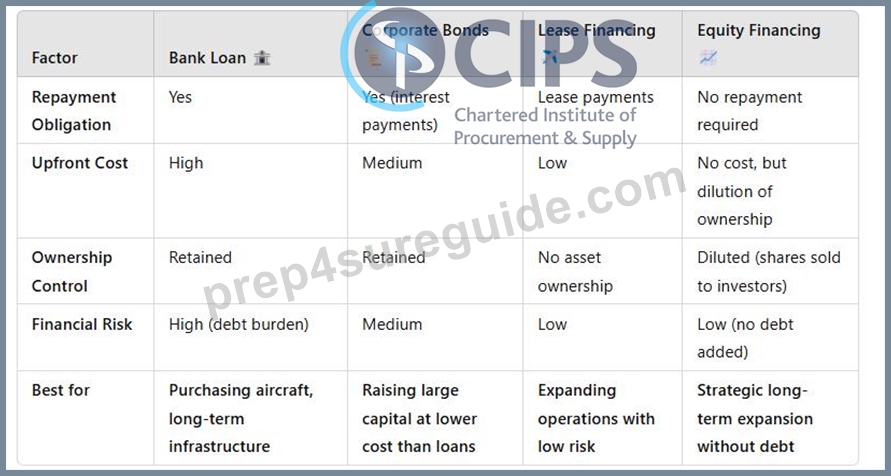
Key Takeaway: Each financing option suits different strategic needs, from ownership-based expansion to flexible leasing.
6. Recommendation: Best Financing Option for XYZ's Expansion
✅ Best Option: Lease Financing (Aircraft Leasing)
Minimizes financial risk while expanding into Asia.
Avoids large upfront costs, preserving cash for operations.
Allows flexibility if the new market underperforms.
Alternative Approach: Hybrid Strategy
Lease aircraft initially → Test the Asian market.
Issue corporate bonds later → Secure long-term funding for growth.
Consider equity financing if a strategic investor is interested.
Final Takeaway:
A combination of leasing for operational flexibility and corporate bonds or equity for long-term financial strength is the best approach for XYZ's expansion into Asia.
NEW QUESTION # 29
SIMULATION
Discuss how XYZ, a global beverage manufacturing organisation, could use the Boston Consultancy Group Framework to impact upon strategic decision making Introduction The Boston Consulting Group (BCG) Matrix is a strategic tool used by organizations to analyze their product portfolio and allocate resources effectively. It classifies products into four categories-Stars, Cash Cows, Question Marks, and Dogs-based on market growth rate and market share.
As a global beverage manufacturing organization, XYZ can use the BCG Matrix to evaluate its product range, identify growth opportunities, and make informed strategic decisions.
1. Explanation of the BCG Matrix
The BCG Matrix is divided into four quadrants:
Example for XYZ:
Star: A fast-growing energy drink brand in emerging markets.
Cash Cow: A flagship cola product with stable market demand.
Question Mark: A new functional health drink with uncertain market acceptance.
Dog: An underperforming diet soda variant with declining sales.
2. How XYZ Can Use the BCG Matrix for Strategic Decision-Making
XYZ can use the BCG Matrix to make resource allocation and investment decisions based on product performance.
3. Advantages of Using the BCG Matrix for XYZ
✅ Resource Allocation - Helps prioritize investment in high-growth products.
✅ Strategic Focus - Identifies which products to grow, maintain, or phase out.
✅ Market Adaptation - Helps XYZ adjust its beverage portfolio based on changing consumer trends.
Example: If XYZ's energy drink (a Star) is experiencing high growth, more marketing and production investment may be justified.
4. Limitations of the BCG Matrix
❌ Ignores Market Competition - A product may have a high market share, but competition could still impact profitability.
❌ Simplistic Assumptions - Not all products neatly fit into one category; market dynamics are complex.
❌ Focuses on Growth and Share Only - It does not consider external factors like profit margins, customer loyalty, or brand strength.
Example: A Question Mark product might have potential, but if consumer preferences shift, it may never become a Star.
5. Application of the BCG Matrix in the Beverage Industry
XYZ can apply the BCG Matrix by reviewing its entire product portfolio across different geographic markets.
Conclusion
The BCG Matrix is a valuable strategic tool for XYZ to analyze its product portfolio, prioritize investments, and make informed market-based decisions. However, it should be used alongside other strategic models (e.g., PESTLE, VRIO) to ensure a comprehensive business strategy.
Answer:
Explanation:
Boston Consulting Group (BCG) Matrix and Strategic Decision-Making for XYZ
NEW QUESTION # 30
SIMULATION
Currency Options and Currency Swaps are instruments used in foreign exchange. Explain the advantages of using these derivatives compared to the use of spot transactions
Answer:
Explanation:
Comparison of Currency Options, Currency Swaps, and Spot Transactions in Foreign Exchange Introduction In international trade and finance, companies dealing with foreign currencies use various financial instruments to manage exchange rate risks. The three main instruments are:
Currency Options - Provide the right (but not obligation) to exchange currency at a fixed rate in the future.
Currency Swaps - A contract to exchange currency flows over a set period.
Spot Transactions - A simple immediate currency exchange based on the current market rate.
While spot transactions offer simplicity, currency options and swaps provide better risk management and flexibility.
1. Currency Options (Flexible Risk Management Tool)
Definition
A currency option gives the holder the right, but not the obligation, to exchange a currency at a predetermined rate on or before a specific date.
✅ Types of Options:
Call Option - Right to buy a currency at a fixed rate.
Put Option - Right to sell a currency at a fixed rate.
Example: A UK importer buying goods from the US purchases a GBP/USD call option to protect against an increase in the exchange rate.
Advantages of Currency Options Over Spot Transactions
✔ Risk Protection - Protects against adverse currency movements while maintaining upside potential.
✔ Flexibility - No obligation to execute the transaction if the exchange rate is favorable.
✔ Ideal for Hedging Future Payments - Useful for businesses with uncertain future cash flows in foreign currencies.
❌ Disadvantages
✖ Premium Costs - Buying options requires upfront payment.
✖ Complexity - More sophisticated than spot transactions.
Best for: Businesses managing currency risk with unpredictable payment schedules.
2. Currency Swaps (Long-Term Hedging Solution)
Definition
A currency swap is a contract between two parties to exchange currency flows over a set period at a predetermined rate.
✅ How It Works:
Companies exchange principal and interest payments in different currencies.
Used to secure long-term financing in foreign markets.
Example: A UK company with a loan in USD enters a GBP/USD swap with a US firm to exchange interest payments, reducing exchange rate risk.
Advantages of Currency Swaps Over Spot Transactions
✔ Long-Term Stability - Protects businesses from long-term exchange rate fluctuations.
✔ Cost Efficiency - Often cheaper than converting currency via spot transactions repeatedly.
✔ Reduces Interest Rate Risk - Useful for companies with foreign currency debt obligations.
❌ Disadvantages
✖ Less Flexible Than Options - The swap contract must be followed as agreed.
✖ Counterparty Risk - Dependent on the financial stability of the other party.
Best for: Companies with long-term foreign currency liabilities (e.g., loans, international contracts).
3. Spot Transactions (Immediate Currency Exchange, No Hedging)
Definition
A spot transaction is a straightforward exchange of currency at the current market rate for immediate settlement (usually within two days).
Example: A European exporter receiving USD payment converts it immediately into EUR using a spot transaction.
Limitations Compared to Derivatives (Options & Swaps)
❌ No Risk Protection - Subject to daily exchange rate volatility.
❌ Not Suitable for Future Obligations - Cannot hedge against expected payments or receipts.
❌ Higher Costs for Frequent Transactions - Repeated spot trades incur forex fees and spread costs.
Best for: Small businesses or one-time transactions with no currency risk concerns.
4. Comparison Table: Currency Options, Swaps, and Spot Transactions
Key Takeaway:
Currency options offer flexibility and protection but come at a cost.
Currency swaps provide long-term stability for large corporations.
Spot transactions are simple but expose businesses to market fluctuations.
5. Conclusion & Best Recommendation
For businesses engaged in international trade, investments, or loans, using currency options and swaps is superior to spot transactions, as they provide:
✅ Protection from exchange rate volatility.
✅ Cost efficiency for large or recurring transactions.
✅ Better financial planning and risk management.
Best Choice Based on Business Needs:
For short-term flexibility → Currency Options
For long-term contracts or loans → Currency Swaps
For one-time currency exchange → Spot Transactions
By selecting the right derivative instrument, businesses can reduce foreign exchange risk and improve financial stability.
NEW QUESTION # 31
SIMULATION
How can Minzburg's 5Ps assist an organisation to develop its global strategy?
Answer:
Explanation:
Mintzberg's 5Ps and Global Strategy Development
Introduction
Henry Mintzberg's 5Ps of Strategy is a framework that helps organizations understand the multiple perspectives of strategy. It recognizes that strategy is not just a planned activity but evolves through deliberate and emergent actions. The 5Ps-Plan, Ploy, Pattern, Position, and Perspective-help organizations develop an effective global strategy by providing a structured approach to decision-making and competitive positioning.
1. Explanation of Mintzberg's 5Ps
Mintzberg's 5Ps define strategy in five different ways, which help in shaping an organization's global expansion and competitive positioning.
2. How Mintzberg's 5Ps Assist in Developing Global Strategy
1. Strategy as a Plan - Setting a Clear Direction for Global Expansion
Organizations develop structured strategic plans for international growth, including market research, investment strategies, and risk assessments.
Example: Tesla planned its global expansion into China by building a Gigafactory, ensuring supply chain efficiency and market entry success.
✅ Benefit: Ensures a structured, well-researched approach to global expansion.
2. Strategy as a Ploy - Gaining Competitive Advantage
Companies use strategic moves to block competitors or gain an early advantage in global markets.
Example: Amazon strategically enters new markets by offering discounts and acquiring local businesses to weaken competitors.
✅ Benefit: Helps organizations counter competition and establish dominance in new markets.
3. Strategy as a Pattern - Replicating Successful Models
If a company has a proven business model, it can apply the same strategy across different regions.
Example: McDonald's follows a pattern-based global expansion model, using standardized menus but adapting products to local tastes (e.g., McAloo Tikki in India).
✅ Benefit: Allows organizations to scale efficiently while maintaining consistency.
4. Strategy as a Position - Establishing a Competitive Market Position
Organizations must decide how they will compete globally-whether through cost leadership, differentiation, or niche markets.
Example: Apple positions itself as a premium brand worldwide, maintaining exclusivity through high pricing and innovation.
✅ Benefit: Helps organizations create a distinctive identity in international markets.
5. Strategy as a Perspective - Aligning Culture and Global Vision
A company's culture and values influence its global strategy.
Example: Patagonia's sustainability-first approach shapes its expansion into environmentally conscious markets, aligning with global CSR expectations.
✅ Benefit: Ensures global expansion aligns with the company's long-term values and mission.
3. Advantages of Using Mintzberg's 5Ps in Global Strategy Development
✅ Holistic Approach - Ensures strategy is not just a rigid plan but adapts to competition and market trends.
✅ Enhances Competitive Agility - Organizations can pivot between strategies (e.g., using a Ploy to disrupt competitors).
✅ Supports Market Adaptation - Helps companies apply Pattern-based expansion while considering local market needs.
✅ Aligns Corporate Vision with Market Positioning - The Perspective approach ensures expansion aligns with organizational values.
4. Limitations of Mintzberg's 5Ps in Global Strategy
❌ Lack of Emphasis on External Factors - Unlike PESTLE or Porter's Five Forces, the 5Ps focus mainly on internal strategy.
❌ Can Be Overly Conceptual - May lack specific actionable steps for implementing global expansion.
❌ Does Not Account for Rapid Market Changes - In fast-changing industries (e.g., tech), rigid strategic planning may become outdated quickly.
Solution: Combine 5Ps with external analysis tools (e.g., PESTLE for macro-environmental risks, BCG for product portfolio management).
Conclusion
Mintzberg's 5Ps of Strategy provide a comprehensive framework for developing global strategies, ensuring that businesses consider planning, competitive moves, consistency, positioning, and cultural alignment. However, it should be used in combination with other strategic models for a well-rounded approach to global expansion and decision-making.
NEW QUESTION # 32
SIMULATION
Explain, with examples, why supply and demand fluctuate in the commodities market
Answer:
Explanation:
Why Supply and Demand Fluctuate in the Commodities Market
Introduction
The commodities market is highly volatile, with prices and availability constantly influenced by fluctuations in supply and demand. These fluctuations arise due to factors such as climate conditions, geopolitical events, economic cycles, and technological advancements.
Understanding why supply and demand shift helps businesses, investors, and policymakers anticipate market trends and mitigate risks.
1. Factors Affecting Supply in the Commodities Market
1.1 Weather and Climate Conditions (Impact on Agricultural Commodities)
✅ Why It Affects Supply?
Droughts, floods, hurricanes, or frosts can damage crops, reducing supply.
Favorable weather leads to higher yields and increased supply.
Example:
In 2019, severe droughts in Australia reduced wheat production, increasing global wheat prices.
A strong coffee harvest in Brazil led to higher supply and lower coffee prices.
Key Takeaway: Agricultural commodity supply is highly dependent on weather variability.
1.2 Geopolitical Events and Trade Restrictions Impact on Energy & Metals)
✅ Why It Affects Supply?
Political instability, sanctions, and wars disrupt supply chains.
Trade policies, tariffs, and embargoes restrict exports/imports.
Example:
Russia-Ukraine war (2022) led to a major disruption in wheat and oil exports, causing global shortages.
US-China trade tensions affected the availability of rare earth metals used in electronics.
Key Takeaway: Supply chains in energy, metals, and food commodities are vulnerable to geopolitical risks.
1.3 Production Costs & Technological Advancements (Impact on Oil, Metals, and Agricultural Goods)
✅ Why It Affects Supply?
Higher production costs (e.g., fuel, labor, mining operations) reduce supply.
New technologies improve extraction and farming efficiency, increasing supply.
Example:
Shale oil extraction technology in the US increased crude oil supply, leading to lower global oil prices.
Higher fertilizer costs in 2023 led to reduced crop production in some countries.
Key Takeaway: Technological advancements increase supply, while rising production costs limit it.
2. Factors Affecting Demand in the Commodities Market
2.1 Economic Growth & Industrial Demand (Impact on Oil, Metals, and Construction Materials)
✅ Why It Affects Demand?
Economic booms drive higher demand for oil, metals, and raw materials.
During recessions, demand for industrial commodities falls.
Example:
China's rapid industrialization (2000s) increased demand for iron ore, copper, and coal, pushing prices up.
COVID-19 lockdowns (2020) caused a sharp drop in oil demand, leading to negative oil prices in April 2020.
Key Takeaway: Commodity demand rises during economic expansion and falls during downturns.
2.2 Changing Consumer Preferences & Market Trends (Impact on Food & Energy Commodities)
✅ Why It Affects Demand?
Shifts in diet, lifestyle, and energy use affect commodity demand.
Green energy transitions reduce fossil fuel demand but increase demand for alternative materials.
Example:
Increased veganism in Western markets boosted demand for soybeans, almonds, and plant-based protein.
Electric vehicle (EV) adoption increased demand for lithium, cobalt, and nickel used in EV batteries.
Key Takeaway: Demand changes due to consumer preferences, technological advancements, and sustainability trends.
2.3 Speculation & Investment Activity (Impact on Gold, Oil, and Agricultural Commodities)
✅ Why It Affects Demand?
Investors and hedge funds buy commodities as a hedge against inflation or currency fluctuations.
Speculative trading increases volatility, driving short-term price spikes.
Example:
Gold prices surge during economic crises as investors seek a safe-haven asset.
Oil price spikes in 2008 and 2022 were partly due to speculative trading.
Key Takeaway: Commodity demand is influenced by financial markets and speculation.
3. How Supply & Demand Interact to Affect Prices
Key Takeaway: Prices are determined by the balance between supply availability and consumer demand.
4. Conclusion
The commodities market experiences constant fluctuations in supply and demand, driven by:
✅ Weather & Climate - Affects agricultural output.
✅ Geopolitical & Trade Issues - Disrupts supply chains.
✅ Economic Cycles & Industrial Growth - Determines demand levels.
✅ Consumer Preferences & Technological Trends - Changes demand patterns.
✅ Speculation & Investor Activity - Influences short-term price volatility.
Understanding these factors allows businesses to forecast commodity price movements, manage procurement risks, and optimize supply chain strategies.
NEW QUESTION # 33
SIMULATION
Examine how an organisation can strategically position itself within the marketplace.
Answer:
Explanation:
How an Organization Can Strategically Position Itself in the Marketplace Strategic positioning is the process by which an organization differentiates itself from competitors and establishes a strong, sustainable presence in the market. It involves making key decisions regarding branding, pricing, customer engagement, and competitive advantage to attract and retain customers.
Below are the key strategies an organization can use to position itself strategically in the marketplace:
1. Competitive Strategy (Porter's Generic Strategies)
Organizations can use Michael Porter's Competitive Strategies to define their market position:
Cost Leadership - Competing on price by offering the lowest-cost products or services.
Differentiation - Offering unique, high-quality, or innovative products that stand out.
Focus (Niche Strategy) - Targeting a specific market segment with specialized products or services.
Example:
Aldi (Cost Leadership) keeps prices low by optimizing supply chains.
Apple (Differentiation) uses innovation and brand exclusivity to dominate the premium tech market.
Rolls-Royce (Focus Strategy) targets a niche luxury segment instead of mass markets.
2. Strong Branding and Market Perception
Organizations must build a strong brand identity to differentiate themselves. This includes:
✅ Consistent Branding - Using logos, colors, and messaging that reinforce identity.
✅ Emotional Connection - Telling a brand story that resonates with customers.
✅ Trust and Reputation - Delivering quality products and services to establish credibility.
Example:
Coca-Cola uses global branding to evoke happiness and refreshment, maintaining strong market dominance.
Tesla markets itself as an innovative, eco-friendly brand, appealing to environmentally conscious consumers.
3. Innovation and Product Development
To maintain a competitive edge, companies must invest in innovation and continuously improve their products/services.
✅ Technology Adoption - Implementing cutting-edge solutions (e.g., AI, automation).
✅ Customer-Centric Innovation - Developing products based on customer needs.
✅ First-Mover Advantage - Being the first to introduce groundbreaking products.
Example:
Amazon's AI-driven supply chain ensures fast deliveries and high customer satisfaction.
Netflix's streaming model revolutionized entertainment consumption, making it an industry leader.
4. Digital Transformation and Market Reach
Organizations can use digital tools and platforms to enhance their strategic positioning:
✅ E-commerce & Online Presence - Expanding reach beyond physical locations.
✅ Social Media & Influencer Marketing - Engaging with customers through digital channels.
✅ Data Analytics - Using customer insights to make strategic decisions.
Example:
Nike's e-commerce growth and direct-to-consumer (DTC) model strengthened its competitive position.
Zara's fast fashion strategy, driven by data analytics, allows quick response to trends.
5. Sustainability and Corporate Social Responsibility (CSR)
Modern consumers prefer brands that demonstrate social and environmental responsibility. Companies can differentiate themselves by:
✅ Sustainable Sourcing - Using eco-friendly materials and ethical suppliers.
✅ Corporate Ethics - Promoting fair labor practices and social initiatives.
✅ Carbon Footprint Reduction - Committing to green energy and carbon neutrality.
Example:
Patagonia's sustainability-first strategy attracts eco-conscious consumers.
Unilever's "Sustainable Living Plan" enhances brand loyalty through ethical business practices.
6. Strategic Partnerships and Market Expansion
Organizations can strengthen their market position through collaborations and global expansion:
✅ Mergers & Acquisitions - Gaining market share by acquiring competitors.
✅ Joint Ventures - Partnering with companies for mutual growth.
✅ New Market Entry - Expanding into emerging markets.
Example:
Google acquiring YouTube enhanced its presence in digital content.
Starbucks' partnership with Nestlé expanded its global coffee distribution.
Conclusion
Strategic positioning requires a clear understanding of competitive advantage, market needs, and innovative growth strategies. By leveraging cost leadership, differentiation, branding, innovation, digital transformation, sustainability, and partnerships, organizations can sustain long-term success in a competitive market.
NEW QUESTION # 34
SIMULATION
Evaluate the following approaches to supply chain management: the Business Excellence Model, Top-Down Management Approach and Six Sigma
Answer:
Explanation:
Evaluation of Approaches to Supply Chain Management
Introduction
Effective supply chain management (SCM) is critical for organizations to enhance efficiency, reduce costs, and improve customer satisfaction. Various management approaches help organizations optimize their supply chain performance. Three widely recognized approaches include:
Business Excellence Model (BEM) - A framework for continuous improvement.
Top-Down Management Approach - A hierarchical decision-making structure.
Six Sigma - A data-driven methodology for process improvement.
Each approach has strengths and limitations when applied to supply chain management.
1. Business Excellence Model (BEM) in Supply Chain Management
Explanation:
The Business Excellence Model (BEM) is a holistic framework used to assess and improve business performance. The European Foundation for Quality Management (EFQM) Excellence Model is one of the most common BEM frameworks.
It focuses on 9 key criteria: Leadership, Strategy, People, Partnerships & Resources, Processes, Customer Results, People Results, Society Results, and Business Performance.
Application in Supply Chain Management
✅ Encourages continuous improvement in supplier relationships and logistics.
✅ Focuses on customer-centric supply chain strategies.
✅ Promotes collaboration with suppliers and stakeholders to optimize efficiency.
Example: Toyota's Lean Supply Chain follows BEM principles to maintain supplier partnerships and quality improvement.
Evaluation
✅ Advantages
Provides a structured framework for evaluating supply chain performance.
Enhances collaboration between internal teams and external suppliers.
Focuses on quality management and customer satisfaction.
❌ Limitations
Can be complex and resource-intensive to implement.
Requires cultural change and strong leadership commitment.
2. Top-Down Management Approach in Supply Chain Management
Explanation:
The Top-Down Management Approach follows a hierarchical structure where decisions are made by senior management and communicated downward. This approach ensures centralized decision-making and strong leadership control.
Application in Supply Chain Management
✅ Ensures consistency in supply chain policies and strategic direction.
✅ Facilitates quick decision-making in procurement and logistics.
✅ Helps maintain compliance with regulatory standards and corporate policies.
Example: Amazon's Supply Chain Strategy is largely top-down, with executives making key strategic decisions on warehousing, delivery, and automation.
Evaluation
✅ Advantages
Ensures strong leadership direction in supply chain management.
Reduces confusion in decision-making by maintaining clear authority.
Useful for large-scale global supply chains that need standardization.
❌ Limitations
Can be rigid and slow to adapt to changing supply chain disruptions.
May reduce innovation and employee engagement in problem-solving.
Less effective in dynamic, fast-changing industries.
3. Six Sigma in Supply Chain Management
Explanation:
Six Sigma is a data-driven methodology aimed at reducing defects and improving quality. It follows the DMAIC cycle (Define, Measure, Analyze, Improve, Control) to enhance process efficiency and minimize errors.
Application in Supply Chain Management
✅ Helps identify waste and inefficiencies in supply chain processes.
✅ Reduces defects and errors in procurement, logistics, and inventory management.
✅ Enhances supplier performance evaluation through data analysis.
Example: General Electric (GE) used Six Sigma to improve supply chain efficiency, reducing defects and operational costs.
Evaluation
✅ Advantages
Reduces supply chain disruptions by improving process reliability.
Uses data-driven decision-making for procurement and logistics.
Improves supplier quality management.
❌ Limitations
Requires intensive training and certification (Black Belt, Green Belt, etc.).
Can be too rigid for industries requiring flexibility and innovation.
Implementation may be costly and time-consuming.
Conclusion
Each approach offers unique benefits for supply chain management:
BEM ensures a holistic, continuous improvement framework for supply chains.
Top-Down Management provides strong leadership direction and centralized decision-making.
Six Sigma improves process quality and operational efficiency.
Organizations should combine these approaches based on their business model, industry requirements, and strategic goals to optimize supply chain performance.
NEW QUESTION # 35
......
Verified L6M2 Exam Dumps Q&As - Provide L6M2 with Correct Answers: https://exam-labs.prep4sureguide.com/L6M2-prep4sure-exam-guide.html